Emergency Fund Basics: How Much and Where to Keep It
What an emergency fund is for, what federal agencies say about its size, where to keep it so it stays safe and reachable, and how to build it in small steps.
Key points
- An emergency fund is cash set aside for unplanned costs or a loss of income, so a bad month doesn't turn into debt.
- There is no single right amount. The CFPB says it depends on your situation; other federal sources mention goals from a few hundred dollars to six months of expenses.
- The fund should be safe, quick to reach and separate from everyday spending. A federally insured savings account meets all three.
- Rates on savings vary widely: the FDIC's national average was 0.37% in September 2026, while some online banks published 3% or more.
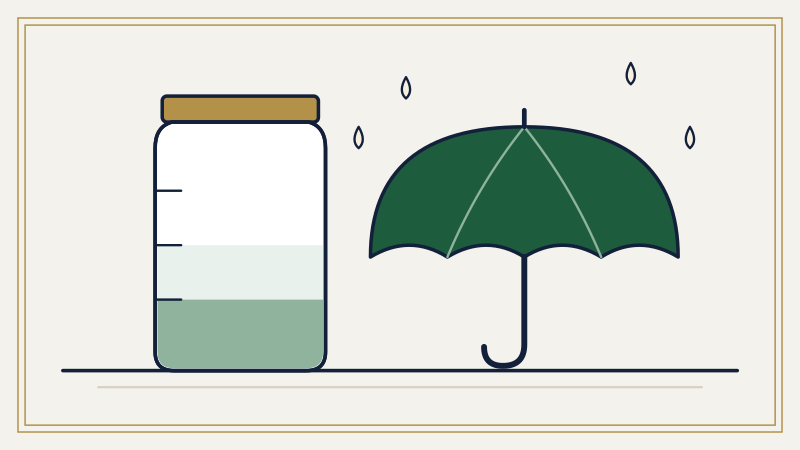
An emergency fund is money you set aside before you need it, so that a broken car, a medical bill or a lost paycheck doesn't go straight onto a credit card. It isn't an investment and it isn't meant to grow much. Its job is to be there, in full, on the worst day of the year.
What the fund is for
The CFPB defines an emergency fund"A cash reserve that's specifically set aside for unplanned expenses or financial emergencies," such as car or home repairs, medical bills or a loss of income. (CFPB) as a cash reserve specifically set aside for unplanned expenses or financial emergencies. Its examples are ordinary ones: car repairs, home repairs, medical bills, a loss of income. The point is to pay for them without borrowing. As the CFPB notes, a one-time emergency paid with a card or a loan can grow much larger than the original bill because of interest and fees.
Many households don't have that cushion. In the Federal Reserve's latest survey of household finances, conducted in October 2025, 63% of adults said they would cover a hypothetical $400 emergency expense with cash, savings or a credit card paid off at the next statement. And 55% said they had set aside three months of expenses in an emergency or rainy day fund; 30% said they could not cover three months by any means, including borrowing or selling something.
How much: what federal sources say
You will often read that an emergency fund should hold "three to six months of expenses". It helps to know who says that, and who doesn't.
| Source | What it says | Date |
|---|---|---|
| CFPB, guide to building an emergency fund | The amount "depends on your situation"; even a small amount helps | Last modified October 29, 2025 |
| FDIC Money Smart | Three to six months is "a big goal"; saving $500 to $1,000 "can make a big difference" | Instructor guide, September 2018 |
| MyMoney.gov | At least three months of needs before you invest | No date shown |
| SEC Investor.gov | A savings goal "such as three to six months of living expenses" | Investor bulletin, 2023 |
| Military OneSource | Three to six months of expenses | Updated July 15, 2026 |
| FDIC | "Financial experts generally recommend" at least six months of living expenses | Updated January 3, 2025 |
The Federal Reserve doesn't recommend an amount; its household survey measures whether people have three months of expenses set aside.
The CFPB's own guide to building an emergency fund gives no number at all. It says the amount depends on your situation, suggests thinking about the most common unexpected expenses you've had and what they cost, and adds that even a small amount can provide some financial security. The FDIC, in a 2025 consumer article, writes that financial experts generally recommend at least six months of living expenses in a federally insured product. Its own Money Smart course, from 2018, calls three to six months a big goal and suggests that $500 to $1,000 already makes a difference.
We don't add a figure of our own, because the useful number is personal. What these sources agree on is the method: count your essential monthly costs, look at the emergencies you have actually faced, and treat any target as something you reach in steps. A first goal you can hit in a few months tends to be more useful than a large one that never starts.
Where to keep it
The CFPB puts it in three words: the fund should be safe, accessible and in a place where you're not tempted to spend it on non-emergencies. For most people that means a savings account, separate from checking, at a federally insuredCovered by FDIC deposit insurance at a bank, or NCUA share insurance at a credit union: up to $250,000 per depositor, per institution, for each ownership category. bank or credit union.
Deposit insurance is what makes "safe" concrete. The FDIC covers $250,000 per depositor, per insured bank, for each account ownership category, and the NCUA gives the same $250,000 of share insurance at federally insured credit unions. The FDIC's coverage includes savings accounts, money market deposit accounts and CDs; it doesn't include stocks, bonds, mutual funds or annuities, even when a bank sells them.
| Option | Federally insured? | How quickly you can reach it | What to watch |
|---|---|---|---|
| Savings account at a bank or credit union | Yes, up to $250,000 | Withdraw when you need to | Rate is usually variable; some accounts have fees or minimums |
| Money market deposit account | Yes, up to $250,000 | Withdraw when you need to | Minimum balances; not the same as a money market fund |
| Certificate of deposit (CD) | Yes, up to $250,000 | At maturity, or earlier with a penalty | Early withdrawal penalty can take some or all of the interest |
| Money market fund | No | Depends on the fund's terms | Not FDIC-insured; value can fall |
| Series I savings bond | Backed by the US Treasury | Not before 12 months | Lose the last 3 months of interest if cashed before 5 years |
Deposit insurance: FDIC and NCUA. Money market funds: SEC Investor.gov. I bonds: TreasuryDirect.
The names can mislead. A money market deposit account is a bank account and is insured. A money market fundAn investment fund, not a bank account. The SEC notes that money in it is not guaranteed by the FDIC, so you could lose some of it. is an investment: the SEC's Investor.gov warns that money in one is not guaranteed by the FDIC and that you could lose some of it.
CDs usually pay more than savings accounts, at the cost of access. The FDIC explains that if you take money out early you will likely pay a penalty or lose some or all of the interest. Federal rules set only a minimum penalty. Banks set the rest: Ally, for example, charges between 30 and 150 days of interest, depending on the CD's term. One approach is to keep part of a larger fund in CDs and part in savings, so the first days of an emergency never touch a CD.
Series I savings bonds are sometimes suggested for longer-term reserves. Bonds issued from May to October 2026 earn a composite rate of 4.26%, but TreasuryDirect is clear about the limits: you can't cash one in during the first 12 months, and before five years you lose the last three months of interest. That makes them a poor fit for money you may need next week.
Treasury bills are the other federal option people mention. TreasuryDirect sells them for terms from four to 52 weeks, in $100 steps, and the interest is subject to federal tax but not state or local tax. They are backed by the US government rather than by deposit insurance, which the FDIC lists as not covering Treasury securities, and you get the money at maturity unless you sell early.
The CFPB also mentions a prepaid card and cash as places some people keep emergency money. Both are quick to reach, but neither earns interest, and the CFPB warns that cash can be stolen, lost or destroyed.
What the money earns
On an emergency fund, safety and access come first, but the rate is not irrelevant. Compare accounts by APYAnnual percentage yield: what a deposit earns in a year once compounding is included. Banks must disclose it on savings accounts and CDs., which federal rules require banks to disclose. The gap between accounts is wide: the FDIC's national average for savings was 0.37% as of September 21, 2026, while Marcus by Goldman Sachs, for one, published 3.50% APY on the same account type as of September 24, 2026. Savings rates can be variable and change after you open the account; the disclosure says so.
Interest is taxable. The IRS treats interest credited to an account you can withdraw from without penalty as income in the year it becomes available, and you should get a Form 1099-INT for $10 or more.
Building it without strain
The CFPB's practical advice is to make saving automatic: set up a regular transfer from checking to savings on payday, and keep an eye on balances so the transfer doesn't cause an overdraft. One-time money, such as a tax refund or a gift, can jump-start the fund, as Investor.gov suggests. If you use the fund, the CFPB's advice is simply to build it back up again.
At work, a newer option may exist. Some retirement plans now include a pension-linked emergency savings account, funded from after-tax pay, with at least one withdrawal allowed each month and a $2,600 limit for 2026 on the balance built from your contributions. Raiding a 401(k) itself is a different matter: withdrawals before age 59 1/2 generally owe a 10% additional tax, with limited exceptions such as one emergency personal expense distribution a year of up to $1,000.
What to consider before choosing
-
What would you actually need to cover?
Start from your essential costs, not your whole budget: housing, utilities, food, insurance, transport, minimum debt payments. The CFPB suggests looking at the unexpected expenses you've had in the past and what they cost.
-
How steady is your income?
A household with irregular pay, one earner or a job in a volatile field may want a larger cushion than one with two steady salaries. That is a judgment only you can make.
-
How fast would you need the money?
A car repair can't wait for a CD to mature. Keep at least part of the fund where you can reach it within a day or two without a penalty.
-
Will you be tempted to spend it?
The CFPB suggests a place where you're not tempted to spend it on non-emergencies. A separate account, even at the same bank, helps.
Questions to ask before you open an account
Ask the bank or credit union these questions, and check the answers in the account's Truth in Savings disclosure:
- Is the institution FDIC-insured or NCUA-insured, and under what exact name?
- What is the APY today, is it variable, and how will you tell me if it changes?
- Is there a monthly fee, a minimum balance, or a fee for transfers?
- How quickly can I move money to my checking account, and is there a limit on withdrawals?
- For a CD: what is the early withdrawal penalty, and how is it calculated?
- For anything called "money market": is it a deposit account or an investment fund?
- Can I set up an automatic transfer on payday, and can I stop it at any time?
Common questions
Should I pay off debt or build an emergency fund first?
It depends on the debt and its rate. The CFPB points out that paying an emergency with a card or a loan can make it grow much larger because of interest and fees, which is the case for having at least a small cushion while you pay debt down.
Is the interest on my emergency fund taxable?
Generally yes. The IRS treats interest credited to an account you can withdraw from without penalty as taxable in the year it becomes available, and you should receive a Form 1099-INT if you earned $10 or more.
Can I use my 401(k) as an emergency fund?
It is possible but costly. Withdrawals before age 59 1/2 usually owe a 10% additional tax on top of income tax. Since 2024 the IRS allows one emergency personal expense distribution a year of up to $1,000 without the additional tax, under conditions.
What is an emergency savings account at work?
Some employers offer a pension-linked emergency savings account inside the retirement plan. You contribute after tax, can withdraw at least once a month, and for 2026 the balance you can build from contributions is capped at $2,600.
What counts as an emergency?
The CFPB lists car repairs, home repairs, medical bills and a loss of income as common examples. It also says not to be afraid to use the fund when you need it, and to build it back up afterward.