Car Insurance Explained: Coverage Types and What You Actually Need
Liability, collision, comprehensive and the rest: what each part of a car insurance policy pays for, which ones the law or your lender requires, and how to choose limits.
Key points
- Liability coverage pays for harm you cause to other people. Nearly every state requires it, and it never pays for your own car.
- Collision and comprehensive pay for your own car. State law doesn't require them, but a lender or leasing company almost always does.
- State minimums are a floor, not a recommendation. If a claim goes above your limits, the rest can become your debt.
- Compare quotes only with identical coverages, limits and deductibles, or you are comparing different products.
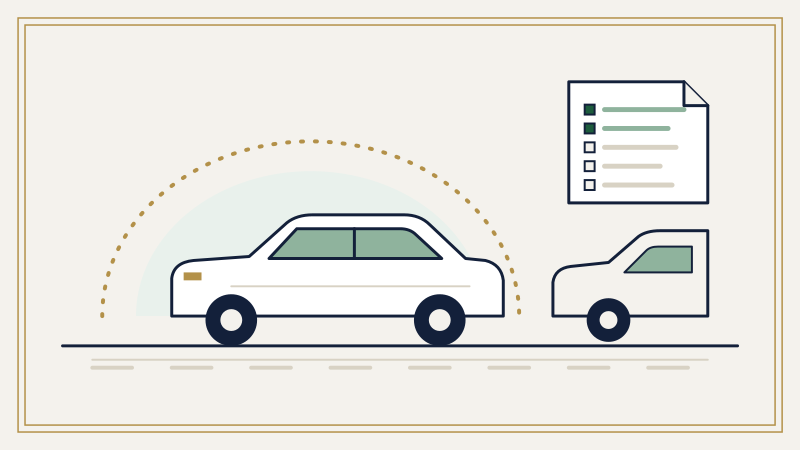
A car insurance policy is several different covers sold together. Some protect other people from you, some protect your own car, and some protect you when the other driver can't pay. Knowing which is which is most of what you need to read a quote, and to notice when two quotes aren't quoting the same thing.
What a policy is made of
Each part of a policy has its own limitsThe most the insurer will pay for a covered claim. Anything above the limit is your responsibility., and the parts that pay for your own car usually have a deductibleThe part of a covered claim you pay yourself before the insurer pays the rest. A higher deductible usually lowers the premium.. The premiumThe price of the policy: what you pay the insurer, monthly or for the whole term, to keep the cover in force. is the sum of the prices of all the parts you choose. That is why two quotes for "the same car" can be far apart: they rarely cover the same set of risks at the same limits.
All of it is summarized on the declarations pageUsually the first page of the policy: it lists the insurer, the cars, the drivers, each coverage with its limits and deductibles, and the premium., usually the first page of the policy. The NAIC describes it as the page that lists the cars, the coverages and their limits, the premium, and any discounts or surcharges. If you only read one page of your policy, read that one.
| Coverage | What it pays for | Who usually requires it |
|---|---|---|
| Bodily injury liability | Medical bills, lost income and legal costs of people you injure, up to your limits | Most states |
| Property damage liability | Damage you cause to other people's cars and property | Nearly every state |
| Collision | Repairs to your own car after it hits, or is hit by, a vehicle or an object | Your lender or leasing company |
| Comprehensive | Theft, fire, flood, vandalism, hitting an animal | Your lender or leasing company |
| Uninsured and underinsured motorist | Your costs when the driver at fault has no insurance or too little | Some states; others require insurers to offer it |
| Personal injury protection (PIP) | Medical bills and some lost income for you and your passengers, whoever caused the crash | No-fault states |
| Medical payments | A smaller amount of medical cover for you and your passengers | Depends on the state |
Rules differ by state and by policy. Your state insurance department publishes the requirements where your car is registered.
For a sense of scale, the NAIC reported a national average premium of $1,438 per insured vehicle in 2023, up 14.42% from 2022. That is the latest year of data, published in February 2026. Your price depends on where you live, what you drive, your record and the covers you choose, and can be far from the average in either direction.
Liability: the part the law requires
Liability coverage pays for harm you cause to others, up to your limits. It has two halves. Bodily injury liability pays the medical bills, lost wages and legal costs of people you injure; property damage liability pays for their car, a fence, a storefront.
Limits are often written as three numbers, such as 30/60/15: up to $30,000 for each injured person, up to $60,000 for all injuries in one accident, and up to $15,000 for property damage. That example is California's minimum, which the state raised on January 1, 2025 from 15/30/5. Every state sets its own rules, and a few are unusual:
| State | Liability minimum | Other required cover | Source and date |
|---|---|---|---|
| California | $30,000 / $60,000 / $15,000 (raised from 15/30/5 on January 1, 2025) | None beyond liability | California DMV, September 2026 |
| Texas | $30,000 / $60,000 / $25,000 | PIP and uninsured motorist are included unless you reject them in writing | Texas Office of Public Insurance Counsel, September 2026 |
| Florida | No bodily injury liability for most drivers; $10,000 property damage | $10,000 PIP | Florida Department of Financial Services, June 2023 |
| New York | $25,000 / $50,000 / $10,000 ($50,000 / $100,000 for death) | No-fault (PIP) and uninsured motorist | New York Vehicle and Traffic Law §311, as revised March 8, 2024 |
Examples only. Check your own state's current rules with its insurance department or DMV before you buy.
Florida is the clearest case of a low floor. Its toolkit for consumers says vehicles registered there need $10,000 of PIP and $10,000 of property damage liability, and bodily injury liability becomes compulsory only after certain accidents or convictions. New Hampshire goes further and doesn't make insurance compulsory at all, though proof of coverage can be required after a conviction or a crash.
The minimum keeps you legal. It doesn't keep you safe: a serious accident can cost far more than a minimum policy pays, and the difference can be claimed from your savings or future income. We would treat the state minimum as the starting line for the conversation with an insurer, not the answer.
Collision and comprehensive: the parts that cover your car
Collision pays to repair your own car after it hits, or is hit by, another vehicle or an object, whoever was at fault. Comprehensive pays for most other damage: State Farm's own description lists theft, fire, vandalism and hitting an animal, and GEICO's adds flood.
Both pay up to the car's actual cash valueWhat your car was worth just before the loss. Depending on the state and the policy, it means fair market value or replacement cost minus depreciation., minus your deductible. The definition varies by state: California's consumer guide defines it, unless the policy says otherwise, as fair market value, while Florida's describes it as the cost to replace minus depreciation. Either way it is usually well below the price of a new car.
Neither is required by state law, but if you financed or leased the car, your contract almost certainly requires both. If you owe more than the car is worth, the payout may not clear the loan. GAP coverage, which dealers and lenders offer, is meant for that gap; the CFPB notes it is optional and can be canceled at any time, which reduces your costs.
Cover for when the other driver can't pay
Uninsured and underinsured motorist coverage pays your costs when the driver at fault has no insurance or not enough. It is not a rare situation: the NAIC cites an Insurance Research Council estimate that 15.4% of motorists were uninsured in 2023, from 5.7% in Maine to 28.2% in Mississippi. Some states require this cover. In Texas it is part of the policy unless you reject it in writing.
Personal injury protection pays medical bills and part of lost income for you and your passengers, whoever caused the crash. It is the core of no-fault systems such as Florida's and New York's, where your own insurer pays your injuries first. Medical payments coverage is a smaller, simpler version available in many other states.
What else changes the price
Beyond coverages and limits, insurers price the driver, the car and the place. Your driving record matters everywhere. Your credit history can matter too, depending on the state: the NAIC notes that some states restrict the use of credit-based insurance scores and several ban it. California, for one, doesn't allow a credit report to be used to decline you or as a premium factor, and its insurers must give drivers who qualify as "good drivers" rates at least 20% lower than they would otherwise charge.
Price is not the only thing to compare. The NAIC's Consumer Insurance Search shows closed complaints by company and state, and many state insurance departments publish complaint indexes that compare complaints with the size of the company. Check that the company and the agent are licensed in your state.
Once you have a policy, it is harder to lose than many people think. The NAIC's guide explains that in most states an insurer can cancel a new policy for any reason only for a limited time, typically 60 days. After that the reasons are limited by state law.
How to compare quotes
A quote is only useful next to another quote for the same thing. Before you ask, write down the cover you want: the liability limits, whether you want collision and comprehensive, the deductible for each, uninsured motorist limits and any extras such as rental car or roadside cover. Give every insurer the same list, the same drivers and the same annual mileage.
When the quotes come back, read the declarations page of each one, not the headline price. Check that the limits and deductibles match what you asked for, and that the term is the same: a six-month premium and a twelve-month premium look very different on a screen. If one quote is much lower, look for a lower limit, a higher deductible or a missing cover before anything else.
What to consider before choosing
-
What could you pay out of your own pocket tomorrow?
Your deductible should be an amount you could cover without borrowing. If a bill of that size would go on a credit card, the lower premium from a higher deductible may not be worth it.
-
What do you own that a lawsuit could reach?
Liability limits protect your savings and future income. People with a home, savings or a high income often choose limits well above the state minimum.
-
What is your car worth today?
Collision and comprehensive pay up to the car's actual cash value, minus the deductible. On an older car, a year of premiums for these coverages can approach what the insurer would ever pay out.
-
Do you still owe money on the car?
If you have a loan or lease, the contract will say which coverages and which maximum deductible you must carry, and whether GAP coverage makes sense.
Questions to ask before you sign
Put these to the insurer or the agent and check the answers against the declarations page before you pay:
- Which coverages does this quote include, and what are the limits and deductible for each one?
- Is uninsured and underinsured motorist coverage included, at what limits, and what happens if I decline it?
- How do you define actual cash value, and does the policy pay for original manufacturer parts or others?
- Who counts as an insured driver: family members, people who live with me, friends who borrow the car?
- Which discounts have you applied, and what would remove one at renewal?
- Do you use my credit information to set the price, as far as my state allows?
- How are claims reported, and who decides where the car is repaired?
- If I cancel mid-term, how is the refund of unused premium calculated, and is there a fee?
Common questions
Is full coverage a type of policy?
No. "Full coverage" is an informal way of saying a policy with liability plus collision and comprehensive. Insurers don't all use it the same way, so ask which coverages and limits a quote actually includes.
Does my insurance follow me if I lend my car to a friend?
In most cases the cover follows the car, so your policy would usually respond first if a friend driving with your permission has a crash. Policies differ, especially for regular drivers who live with you, so check your policy's definition of an insured driver.
Does a higher deductible always lower the price?
It usually lowers the premium for collision and comprehensive, because you take on more of each claim. It has no effect on liability, which pays other people and has no deductible.
Can the insurer cancel my policy whenever it wants?
Not after the first weeks. The NAIC explains that in most states an insurer can cancel a new policy for any reason only for a limited time, typically 60 days, and must give advance notice. After that, state law limits the reasons; in California there are only three.
Can I cancel my own policy?
Yes, for any reason, according to the NAIC. Line up the new policy first so the car is never uninsured, and ask the old insurer how any refund of unused premium is calculated.